
A Complete Guide on a Fintech GCC Setup in India
A fintech GCC in India is a dedicated capability center that enables a fintech company to build and manage product engineering, data, AI, cybersecurity, cloud, payments and other financial-technology operations. Setup involves more than hiring business case → operating model → location → legal structure → talent → technology → governance → launch → scale. India is a strong option because of its mature GCC ecosystem, specialized talent and digital capabilities.
Key Takeaways
- India has a mature GCC ecosystem, with 2,117 GCCs and 2.36 million professionals reported for FY2026.
- A fintech GCC should be designed around business capabilities and outcomes, not headcount alone.
- Product engineering, AI, data, cybersecurity and financial platforms can become core GCC capabilities.
- Location selection should consider talent, fintech ecosystem, infrastructure, operating costs, and scalability.
- Security, compliance and governance should be incorporated into the fintech GCC in India from the beginning.
- Indian GCCs are increasingly moving toward specialized, high-value capabilities, including AI and product engineering.
What Is a Fintech GCC?
A fintech global capability center is a dedicated center that enables a fintech company to build and manage capabilities such as product engineering, AI, data, cybersecurity, cloud and financial technology operations. Unlike traditional outsourcing, where a vendor delivers contracted services, a GCC is designed to integrate capabilities more closely with the enterprise. However, ownership varies across captive, partner-enabled and GCC-as-a-Service models.
Project-oriented
External delivery
Limited ownership
Variable strategic involvement
Capability-oriented
Extension of global organization
Greater potential for IP and process ownership
Potential for product ownership
A GCC can therefore operate alongside outsourcing rather than simply replace it. Financial-services organizations increasingly use hybrid models, combining GCCs with strategic external providers for different capabilities.
Why Set Up a Fintech GCC in India?
India offers a strong combination of technology talent, fintech expertise and GCC maturity. Its deep engineering ecosystem provides access to cloud, data, AI and software-development skills, while its established financial-services and fintech ecosystem adds relevant domain knowledge. EY identifies talent, policy, capital, and digital infrastructure as core attributes of strong fintech ecosystems.
India also provides scalability. Companies can start with specialized teams and expand capabilities as requirements grow. Current GCC research shows the model moving beyond cost-focused delivery toward strategic capability building, AI, engineering, and innovation.
This makes a fintech GCC in India relevant for product engineering, AI, data and R&D, not simply support functions. EY reports that 58% of Indian GCCs were investing in agentic AI in 2025, while Deloitte highlights increasing GCC value from engineering, data science, digital products and AI/ML.
What Functions Can a Fintech GCC Handle?
A fintech GCC can support both technology delivery and strategic financial technology capabilities. The right portfolio depends on the fintech's products, operating model and growth priorities.
Data Engineering
AI/ML
Cloud
Cybersecurity
Payments
Risk
RegTech
QA
Product
Data pipelines, warehouses, analytics
Fraud, risk, forecasting, personalization
Architecture, migration, DevOps
Security engineering, monitoring
Payment infrastructure and integrations
Risk analytics and automation
Compliance technology
Testing and quality engineering
Product management and architecture
These capabilities can form the foundation of fintech GCC solutions, from product development and data platforms to AI-driven risk management and secure payments.
A fintech GCC should prioritize functions where India-based teams can create measurable strategic value. That means considering product ownership, specialized talent, technology complexity, and long-term scalability rather than transferring functions simply because they can be delivered remotely.
How to Set Up a Fintech GCC in India: 7-Step Framework
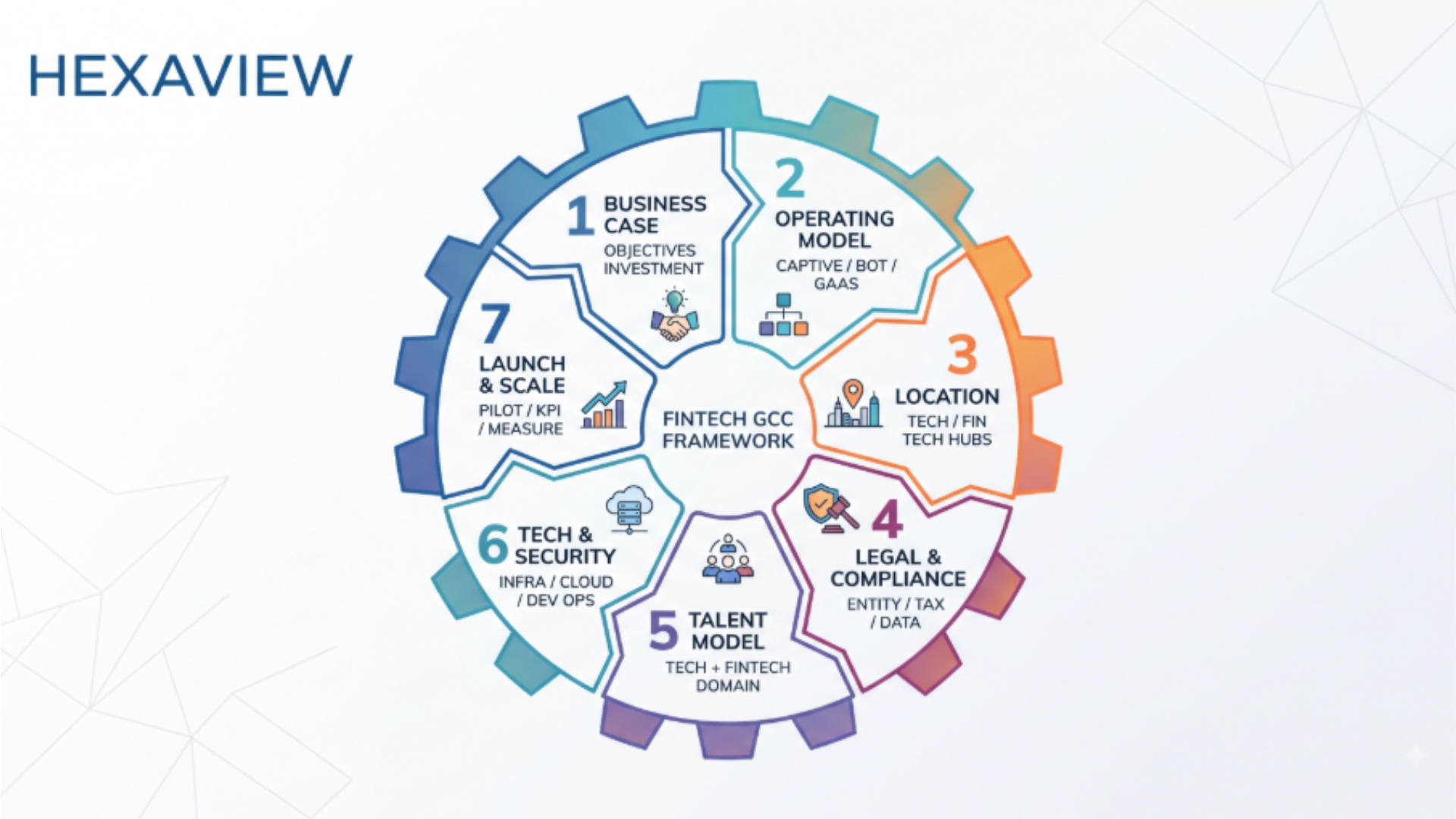
Step 1: Define the GCC Business Case
Start by identifying which capabilities the GCC should own, not how many people to hire. Define the business problem, functions moving to India, expected investment and measurable outcomes. This creates a clear foundation for the fintech GCC strategy.
Step 2: Select the Right Operating Model
Choose between a captive GCC, Build-Operate-Transfer, GCC-as-a-Service or partner-enabled model. The decision should reflect the required level of control, speed of setup, investment capacity, and long-term ownership.
Step 3: Choose the Location
Match the city to the GCC mandate:
- Technology-heavy: Bengaluru, Hyderabad
- Financial-services-heavy: Mumbai, GIFT City
- Engineering-heavy: Pune, Chennai
- BFSI/enterprise-heavy: Delhi NCR
GIFT City is distinct because its IFSC ecosystem specifically supports banking, capital markets, insurance, and fintech activities.
Step 4: Establish Legal, Tax and Compliance Foundations
Evaluate the appropriate entity structure, foreign investment considerations, tax and employment requirements, data protection, cybersecurity, contracts, IP and audit requirements. Financial-sector obligations will vary according to the fintech's business model, data flows, and regulated activities.
Step 5: Build the Fintech Talent Model
Combine technology expertise with fintech domain knowledge. Roles can include engineering leaders, software and data engineers, ML specialists, cloud engineers, cybersecurity professionals, product managers, payments specialists, risk analysts and compliance-technology specialists.
The goal is not the largest team. It is the right capability mix.
Step 6: Establish Technology and Security
Build cloud infrastructure, data architecture, DevOps, CI/CD, identity and access management, application security, data governance, disaster recovery and monitoring into the operating foundation. For fintech companies, security and resilience should be architectural requirements, not afterthoughts.
Step 7: Launch, Measure and Scale
Use a phased model:
Pilot → Stabilize → Expand → Optimize
Track KPIs such as time-to-market, release frequency, engineering productivity, automation rate, cost per capability, defect rate, talent retention and business impact. Scale the GCC when performance data demonstrates that additional capabilities can create measurable value.
Fintech GCC Solutions: What Should They Include?
Fintech GCC solutions should cover the full capability lifecycle rather than provide disconnected technology services. A strong model typically includes four layers:
Technology
Fintech
Operations
Product engineering, cloud, AI, data and cybersecurity
Payments, lending, wealthtech, financial platforms and RegTech
Talent, governance, DevOps, QA and scaling
Hexaview Technologies has experience building GCCs for financial services and fintech organizations, including a US-based fintech GCC covering payments, blockchain, personal finance and related technology capabilities. Its current fintech portfolio also spans payments, insurance, RegTech, blockchain, and personal finance.
The strongest fintech GCC services connect these layers: strategy → technology → fintech capabilities → operations → continuous scaling. This creates an integrated capability center rather than a collection of disconnected services.
Fintech GCC Cost: What Actually Determines the Investment?
There is no universal setup cost for a fintech GCC in India. Investment depends on team size, talent mix, city, office model, technology infrastructure, legal setup, compliance, security, leadership, and the chosen operating model. Partner involvement can also change the initial cost profile, particularly in GCC-as-a-Service or Build-Operate-Transfer models. EY identifies talent, IT infrastructure, facilities and operating-model choices as important GCC cost considerations.
The more useful approach is to evaluate GCC economics against capability output, including engineering productivity, product velocity, automation and business impact—not salary savings alone. Modern GCCs are increasingly designed around value creation and specialized capabilities.
Frequently Asked Questions
1. What is a fintech GCC in India?
A fintech GCC in India is a dedicated capability center that supports functions such as product engineering, AI, data, cybersecurity, cloud and financial-technology operations for a global fintech organization.
2. Why are fintech companies setting up GCCs in India?
India offers specialized technology talent, an established GCC ecosystem and strong fintech capabilities. A fintech GCC also enables companies to build scalable teams and develop long-term capabilities rather than relying only on external delivery.
3. What services can a fintech GCC provide?
A fintech GCC can provide engineering, AI, data, cloud, cybersecurity, product development and fintech capabilities. These may include payments, financial platforms, analytics, automation, application modernization, and RegTech, depending on the organization's requirements.
4. How much does it cost to set up a fintech GCC in India?
There is no fixed setup cost. Investment varies according to location, team composition, infrastructure, security requirements, leadership needs, and operating model. Companies should evaluate the investment against capability output and measurable business outcomes rather than salary savings alone.
5. How can Hexaview help with fintech GCC setup?
Hexaview has documented experience building GCCs in India, including a fintech GCC covering payments, blockchain, robo-advisory and personal finance. Its capabilities include GCC setup, talent acquisition, infrastructure, cybersecurity, fintech engineering, AI, data, and modernization.